
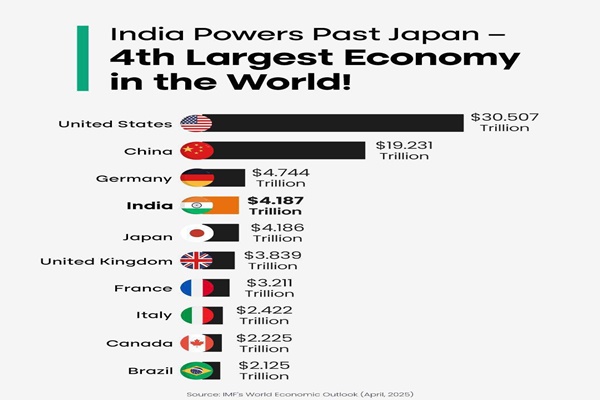
ndia has become the 4th largest economy in the world, passing big nations like Germany and the UK. This is a huge achievement not only for the Indian government but also for every Indian citizen. But what does this actually mean? How does it affect your life? Why is the world watching India closely now?
This article answers all these questions in simple language, so anyone can understand the truth behind this big news. Whether you are a student, job-seeker, business owner, or homemaker—knowing about this can help you understand India’s future, your job opportunities, and your role in this growing economy.
We will also explain how this happened, what sectors helped India grow, what problems still remain, and how India compares to other top economies. If you want to understand your country’s future and your own, read till the end.
🔍 What Does “India is the 4th Largest Economy” Mean?
When we say that India is the 4th largest economy, it means India now has the fourth highest Gross Domestic Product (GDP) in the world. GDP is the total value of all goods and services a country produces in a year.
As per the latest data, India’s GDP is around $4 trillion, which makes it bigger than economies like Germany, UK, and France.
Key points to understand:
- GDP shows the economic strength of a country.
- A higher GDP means a stronger economy, more jobs, and better global status.
- India’s growing GDP means that industries are growing, exports are increasing, and people are spending more.
🚀 How Did India Become the 4th Largest Economy?
India’s rise did not happen in one day. It took years of effort by governments, businesses, and the people. Here are the main reasons behind this growth:
📈 1. Strong IT and Software Industry
India’s software exports have grown a lot. Companies like Infosys, TCS, and Wipro earn billions of dollars from clients all over the world.
🏭 2. Growing Manufacturing Sector
India’s Make in India initiative helped boost manufacturing in sectors like automobiles, smartphones, and chemicals.
🌾 3. Agriculture and Rural Development
India is one of the largest food producers in the world. Improved farming techniques and government support helped boost rural income.
👨🎓 4. Young Population
India has a large and young workforce. This means more people are working, earning, and spending.
🏦 5. Economic Reforms
Important reforms like GST, digital payments, and FDI policies made it easier to do business in India.
📊 India vs Other Top Economies (2025)
India is now only behind these 3 countries:
| Rank | Country | GDP (Approx) |
|---|---|---|
| 1 | United States | $28 trillion |
| 2 | China | $18 trillion |
| 3 | Japan | $4.4 trillion |
| 4 | India | $4 trillion |
| 5 | Germany | $3.9 trillion |
India is likely to overtake Japan in the coming years if the growth continues.
💡 What Are the Benefits of Being the 4th Largest Economy?
Becoming a global economic power brings many benefits for the country and its people.
🔹 1. More Foreign Investment
Global companies want to invest in big economies. India will attract more factories, offices, and projects.
🔹 2. Job Creation
As investment grows, more jobs will be created in IT, manufacturing, and services.
🔹 3. Better Infrastructure
With more money, the government can build better roads, airports, trains, and hospitals.
🔹 4. Stronger Rupee
A strong economy helps in reducing inflation and increasing the value of the Indian Rupee in the global market.
🔹 5. Global Respect
India now has a strong voice in global issues, trade talks, and climate discussions.
❗ Challenges India Still Faces
Even after becoming the 4th largest economy, India faces many problems that need attention.
⚠️ 1. Unemployment
Many people, especially the youth, are still struggling to find good jobs.
⚠️ 2. Poverty and Inequality
A large part of the population still lives in poverty, with no access to clean water, healthcare, or quality education.
⚠️ 3. Education and Skill Gap
Our schools and colleges need to improve. We need more skill-based training for youth.
⚠️ 4. Inflation
Prices of daily items like vegetables, fuel, and medicines are still high for the common man.
⚠️ 5. Corruption and Red Tape
Doing business is still hard in some areas due to slow paperwork and corruption.
🧠 How Does This Affect Common People?
Now you may ask, “How does this news help me?”
Here is how India’s growing economy affects you directly:
- More jobs in cities and small towns
- Better roads, trains, and mobile networks
- Higher income opportunities through digital platforms
- Affordable goods due to large-scale production
- More foreign brands and services coming to India
🏛️ Role of Government Policies
The Indian government played a big role in this growth through smart policies:
- Make in India: Boosted manufacturing
- Startup India: Encouraged young entrepreneurs
- Digital India: Increased online access in villages
- PLI Scheme: Attracted companies to set up plants in India
- GST Reform: Made one national market instead of state-wise taxation
🌍 Future Goals for India
India is not stopping here. The target is to become the third-largest economy by 2027, ahead of Japan.
Goals for the next 5 years:
- Reach $5 trillion GDP
- Improve education and health
- Achieve 100% digital banking
- Increase green energy use
- Reduce dependence on imports
📚 FAQs on India as the 4th Largest Economy
❓ 1. When did India become the 4th largest economy?
India became the 4th largest economy in early 2025, surpassing Germany in terms of GDP.
❓ 2. What does GDP mean?
GDP (Gross Domestic Product) is the total money value of everything a country produces in one year.
❓ 3. How is this growth helpful to common people?
It brings more jobs, better services, cheaper products, and improved infrastructure for everyone.
❓ 4. Will India become the 3rd largest economy?
Yes, many experts believe India will pass Japan and become the 3rd largest economy by 2027 or 2028.
❓ 5. What sectors helped India grow?
Major sectors include IT and software, manufacturing, agriculture, digital finance, and exports.
📝 Conclusion
India becoming the 4th largest economy is a moment of pride and opportunity. It shows the hard work of millions of Indians—from farmers to techies. But with growth comes responsibility. The focus now must be on creating jobs, improving education, and reducing inequality.
Every Indian has a role to play in this journey—whether by learning new skills, supporting local businesses, or simply staying informed. The world is now looking at India not just as a country, but as a rising global power.
Keep watching this space—because India’s growth story has just begun.
Read Also- Multi-Currency Forex Card